Session 1 · CREATE: Experiment
Drones, thirds and fifths
- 7 minWarm-up: posture, breath, sirens, and echo-singing short patterns.
- 18 minDrone discovery (see activities): half the class holds a drone on C while the other half sings up the C major scale. Which notes sound restful over the drone? Find the 3rd (E) and the 5th (G).
- 10 minMini-lesson: intervals are the distance between two notes. Unison, a 3rd and a 5th sound sweet together. Now change the drone to A: the same tune feels more like A minor. Major often sounds bright, minor darker.
- 10 minSing a short melody over a C drone, then over an A drone. Vote: which suits a lullaby? Which suits a celebration?
- 5 minCool-down. Write in your part map: the notes C, E and G make a C major chord.
Session 2 · CREATE: Experiment
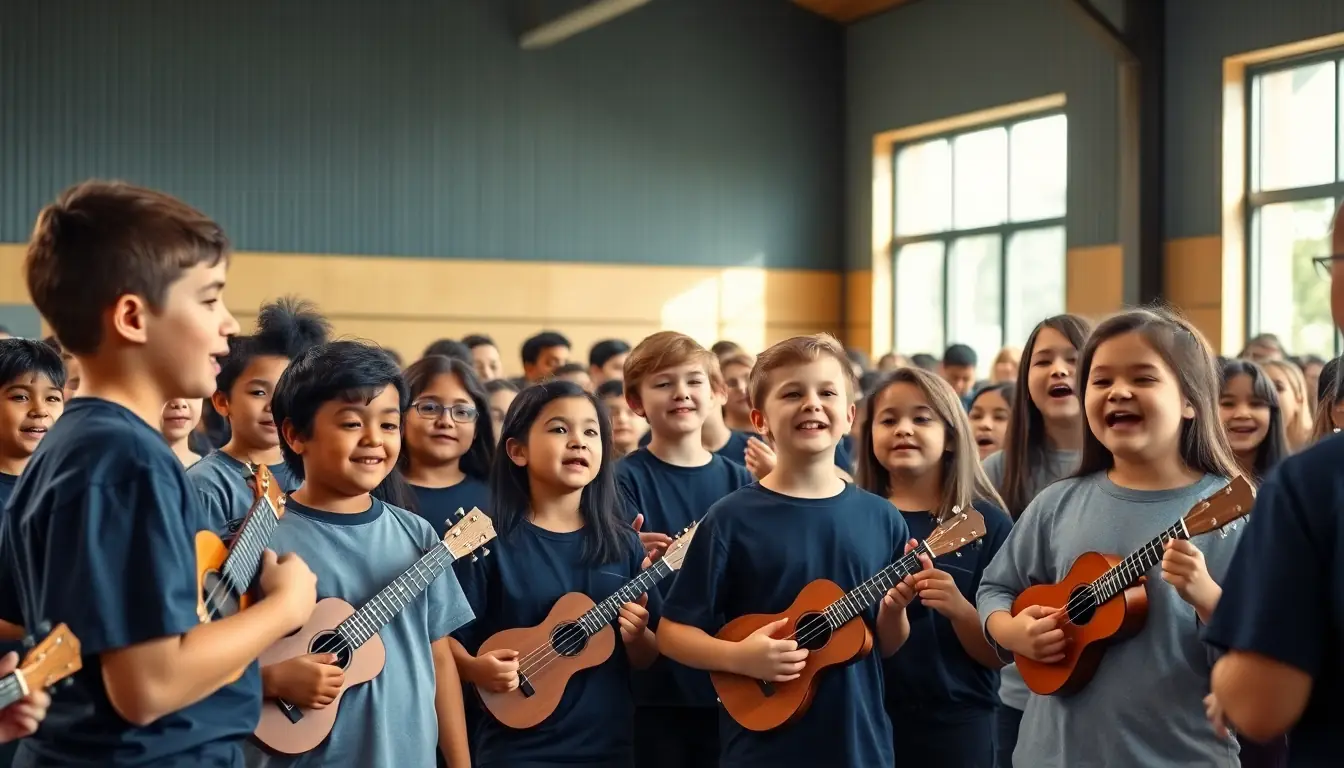
Four chords on the ukulele
- 7 minWarm-up, then tune the ukulele together (G, C, E, A: 'Good Cooks Eat Apples').
- 18 minUkulele chord lab (see activities): learn C (one finger), Am (one finger), F (two fingers) and G7 (three fingers). Practise changing between C and Am on a steady count of four.
- 10 minStrum a simple down-down-up-up-down pattern on C, then hold it under the class singing the round.
- 10 minPairs: one strums C and G7 while the other sings a simple two-chord song. Swap. Notice when the chord needs to change.
- 5 minRest fingers. Pīwakawaka asks one question about which chord change was hardest and why; jot your answer.
Getting started
Start with C and Am only: they use just one finger each. Strum four times on each.
Stretch
Sing a 3rd above the melody for one line of a song you know. Then try a line a 3rd below.
Checkpoint
Everyone can hold a drone while others sing, and can play at least two ukulele chords and change between them in time.
Activities for this week
- Drone discovery: Which notes sound restful over a drone, and which sound tense?
- Ukulele chord lab: How few fingers do you need to play hundreds of songs?
Useful this week
- Chrome Music Lab: Song Maker ↗ Try melodies over a bass line and hear how the harmony changes, in the browser.
- Lessons ↗ Clear, free lessons on notes, intervals and chords.