The Arts · World 6 of 8 · Years 7–8
Harmony: Singing and Playing Together
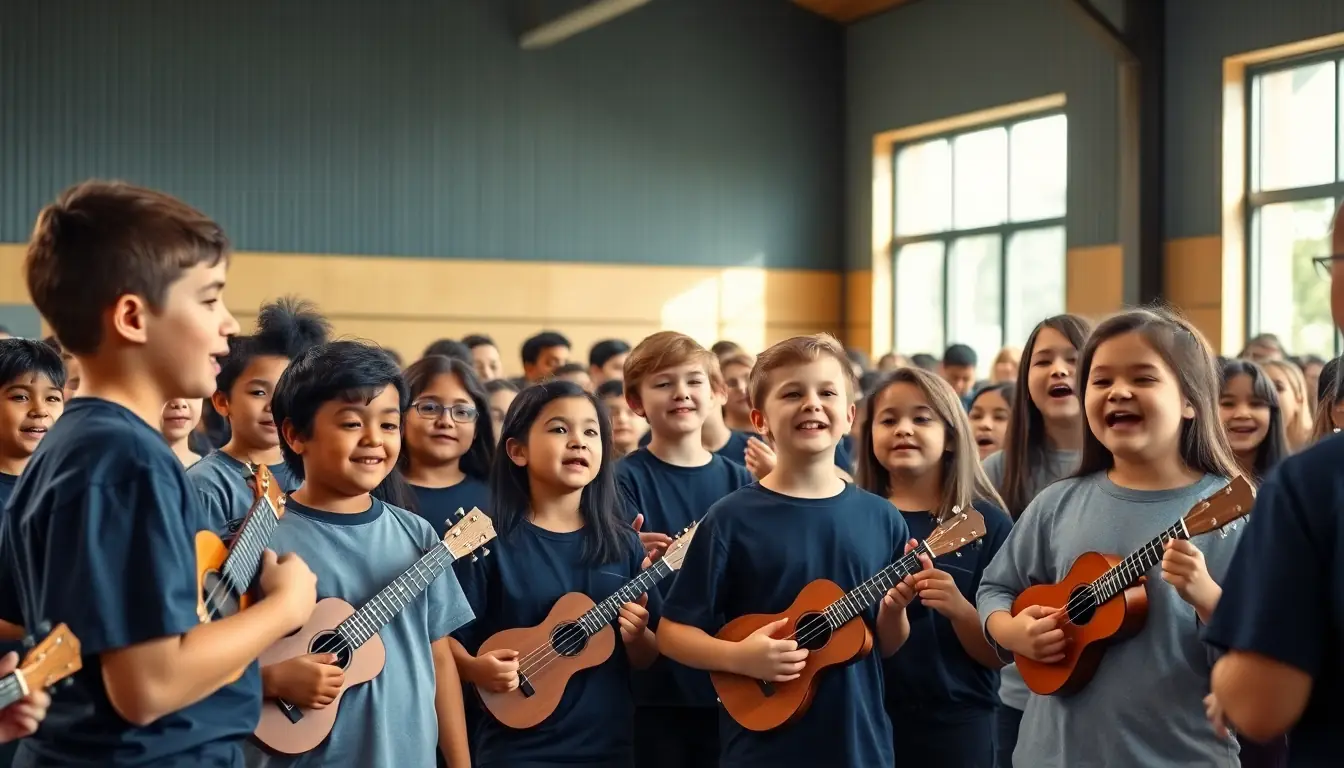
One voice is a tune. Twenty voices, four ukulele chords and a bass line are harmony. Build a sound bigger than any of you alone.
Big question: What does it take for a group of people to sound like one, and how do different traditions use harmony to bring people together?
- You'll make
- A 4–6 minute class performance set: one round in three or four parts, and one song arranged with a melody, a harmony line, ukulele chords and a bass line on keyboard, xylophone or bass ukulele. The set has a planned intro and ending and at least one deliberate change of dynamics (soft to loud). Each student also keeps a part map showing what they sing or play in each section, and the class gives a short spoken introduction.
- For
- Whānau and the school community at an assembly or evening, or residents of a local rest home or community group
- Time
- 5 weeks · 2 sessions a week
Your mission
Why it matters
Your class has been invited to perform a short set of songs: at a whānau evening, a Pacific language week assembly, or a visit to a local rest home where the residents grew up singing together. The brief is simple: it has to be in harmony, with singing and instruments, and everyone in the class has a part. You have five weeks, a box of ukulele, whatever instruments the school owns, and your voices.
People have sung together for as long as there have been people: in churches and on marae, on the ships that carried settlers here, in Pacific choirs whose harmonies can fill a hall without a microphone. Singing and playing in harmony teaches you to listen as hard as you perform, to hold your own part while hearing everyone else's, and to trust the people beside you. Those are musical skills, but they are also life skills. And the feeling when twenty voices lock into a chord is hard to beat.
Your first step
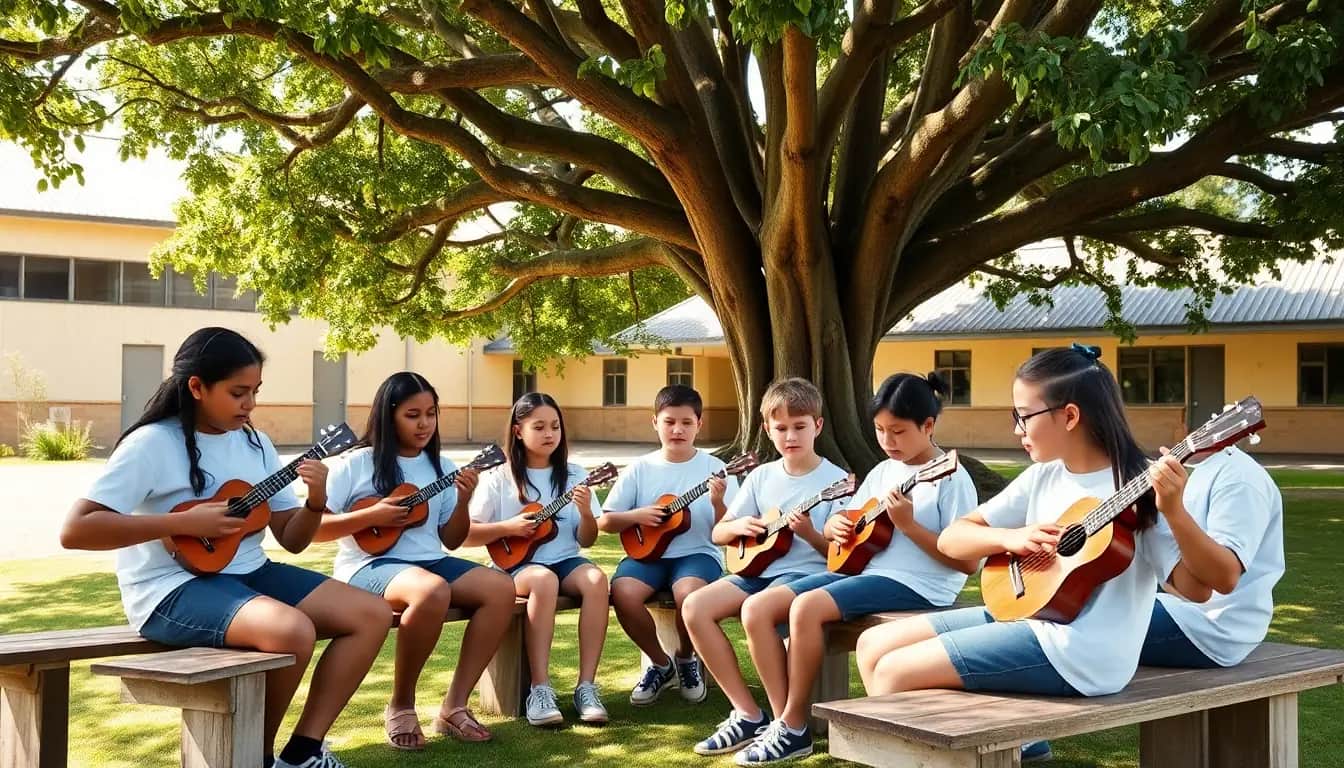
Hum one long, steady note with the whole class. Now half the class keeps humming while the other half slides slowly up until it sounds sweet, not sour. You just found a harmony. How did you know when it sounded right?
Make it yours
Choose a context
Same big question, three different places to explore it. Pick the one that fits your class and community.
Songs of welcome and belonging
Many schools have their own waiata, and many families in your class sing songs in te reo Māori, Samoan, Tongan, Hindi, Mandarin, Tagalog or other languages at home. Build a set about belonging: a round everyone can learn, and a song of welcome. Waiata are learned only with the guidance and permission of the school's kapa haka tutor, kaumātua or iwi partner, who can explain the meaning and the right way to perform them. Songs from other cultures come with the help of someone from that community.
Pacific voices: choirs and island strum
Samoan and Tongan church choirs in Aotearoa are famous for rich, many-part harmony, and the ukulele strum is part of life across the Pacific. Invite a parent, church choir leader or Pacific music tutor to share how their choir learns parts by ear, and how songs are passed on. Then arrange a song in two or three parts with ukulele, and perform it for a Pacific language week or Polyfest-style assembly.
A community sing: songs for our elders
From the 1920s, New Zealand towns held 'community sings' where everyone sang rounds, folk songs and hymns together. Revive the idea: learn rounds from around the world (such as 'Frère Jacques' in several languages or 'Dona nobis pacem') and songs your grandparents know, then take your set to a local rest home, a seniors' group or a community hall. Invite the audience to join the last chorus.
CREATE
Week by week
Two sessions a week, each with Getting started and Stretch support so the whole class works together.
- W1Voices together: what harmony is and how different traditions use itConnect: One sound from many voices · Respond: Harmony traditions
- W2Experiment with drones, intervals, chords and ukuleleExperiment: Drones, thirds and fifths · Experiment: Four chords on the ukulele
- W3Arrange the music: melody, bass line and parts for everyoneArrange: Melody and bass line · Arrange: Build the arrangement
- W4Transform the sound: balance, blend, phrasing and feedbackTransform: Balance and blend · Transform: Phrasing, dynamics and a sound from te ao Māori
- W5Exhibit: perform for a real audience and reflectExhibit: Dress rehearsal · Exhibit: Performance and reflection
Hands-on
Activities
Investigations and projects that fit the weeks above. Open one to see what you need and how you'll know it worked.
Round upHow can the same tune sung at different times make harmony?Open
You need: a simple round (for example 'Frère Jacques' or 'Dona nobis pacem') · a clear space to stand in groups · a conductor
- Learn the round in unison until everyone knows it well.
- Split into two groups. Group 2 starts when Group 1 reaches line 2.
- Keep your eyes on the conductor and your ears on the other group.
- Add a third group, then a fourth.
- Try an ending where each group stops in turn, so the round thins out to one voice.
How you'll know: Your group holds its part without joining the others, and you can hear the harmony when all parts overlap.
Safety: Sing at a comfortable volume; never shout to keep your part.
Go further: Sing the round in two languages at once (for example English and French, or English and a language from your class).
Fits week 1 →See, hear, wonder: harmony traditionsHow do different traditions use harmony?Open
You need: four short recordings: a school or youth choir, a Pacific church choir, a barbershop quartet, a waiata-ā-ringa with guitar · a page with columns: Hear / Think / Wonder
- Listen to each recording once just to enjoy it.
- Listen again and write what you hear: how many parts, voices or instruments, who leads, any body percussion.
- Write what you think the song is for (worship, welcome, celebration, entertainment), with a clue.
- Write questions you would ask someone from that tradition.
- Compare with a partner: which traditions sing without instruments (a cappella)? Which use a strong leader?
How you'll know: Your notes separate what you hear from what you guess, and your questions show respect for the people who hold these songs.
Go further: Read about the New Zealand Youth Choir or Pacific church choirs on Te Ara and share one fact with the class.
Fits week 1 →Drone discoveryWhich notes sound restful over a drone, and which sound tense?Open
You need: a keyboard, xylophone or ukulele to give the starting note · the class split into two groups
- Group 1 hums a steady C (the drone). Breathe in turns so the sound never stops.
- Group 2 sings slowly up the scale: C, D, E, F, G, A, B, C.
- Stop on each note. Does it feel restful or does it want to move?
- Mark the restful notes. You should find the 3rd (E) and 5th (G).
- Change the drone to A. Sing the same tune. Does it feel brighter or darker?
How you'll know: You can find the 3rd and 5th above a drone by ear and describe how changing the drone changed the mood.
Go further: Make up a four-bar tune that uses only C, E and G over the drone, then add a note that creates tension and resolve it.
Fits week 2 →Ukulele chord labHow few fingers do you need to play hundreds of songs?Open
You need: a ukulele tuned G–C–E–A (one between two) · chord cards for C, Am, F and G7 · a steady beat
- Hold the ukulele with the neck to your left (or right if you are left-handed), and strum over the sound hole with a relaxed wrist.
- C: third finger on the third fret of the A string (the one nearest the floor). Strum four times.
- Am: second finger on the second fret of the top string (G). Strum four times.
- Switch between C and Am every four beats without stopping. Then add F and G7 from the cards.
- Play C–Am–F–G7 as a loop while the class sings a round over it.
How you'll know: You can change between at least two chords in time without stopping the beat, and hear when a chord fits the melody.
Safety: Keep practice short at first (10–15 minutes) and press lightly: fingertips toughen over a few days.
Go further: Learn a Pacific-style 'island strum' (down, down-up, up-down-up) and use it for the whole loop.
Fits week 2 →Melody plus bassHow does a bass line change the way a melody sounds?Open
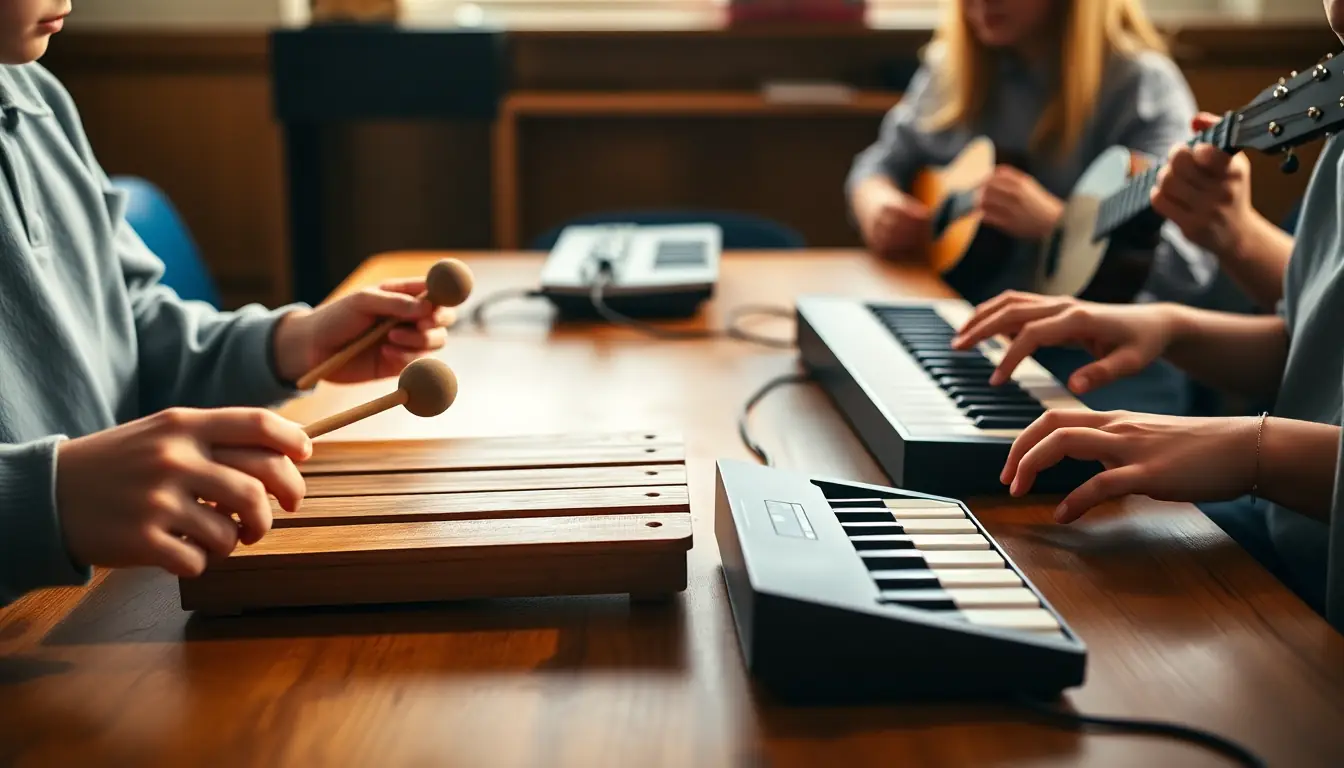
You need: a keyboard, xylophone, chime bars or bass ukulele · a melody on a lyric-and-note chart · the chord names for each bar
- Find the root note of each chord on your instrument: C, A, F, G.
- The whole class sings or plays the melody while the bass group plays one root note at the start of each bar.
- Swap roles so everyone tries the bass part.
- Split into groups of four: two on melody, two on bass. Keep together without the teacher.
- Try it in pairs: one melody, one bass.
How you'll know: The bass changes when the chords change, and your pair can keep together to the end.
Go further: Play two notes per bar in the bass (the root and the 5th) to make it move.
Fits week 3 →Part mapHow do we make sure every person knows their part in every section?Open
You need: a large chart of the song's sections · coloured pens (one colour per part) · each student's own part-map page
- List the sections across the top: intro, verse 1, chorus, verse 2, chorus, ending.
- List the parts down the side: melody, harmony, ukulele chords, bass, drone or percussion.
- Colour in who plays or sings in each section. Keep the intro and first verse thin; make the last chorus the fullest.
- Mark dynamics (p, f, cresc.) and breathing points.
- Each student copies their own row onto their part map.
How you'll know: Every student can say what they do in each section, and the chart shows a clear build from thin to full texture.
Go further: Add a moment where only voices sing (a cappella) and explain why it will matter to the audience.
Fits week 3 →Record, listen, adjustWhat does our ensemble really sound like from the audience?Open
You need: a phone or tablet on a stand at audience distance · a speaker for playback · feedback cards
- Set the device where the audience will sit and record one full run.
- Listen back once all the way through without talking.
- Listen again part by part: can you hear the melody? The harmony? The bass?
- Give feedback with 'I notice… I wonder… What if…' about the group, not individuals.
- Choose two changes, rehearse them and record again. Compare the two recordings.
How you'll know: The second recording shows the changes you chose, and every part can be heard.
Safety: Keep recordings within the class; share them only with consent and following the school's media policy.
Go further: Draw a 'balance meter' for each part (too soft, just right, too loud) for both recordings.
Fits week 4 →Look closer
From the real world
Background reading
Read to understand
Short readings written for Kōkiri Learn students, with their sources.
- Two notes are better than one: how harmony worksUnison, rounds, drones, intervals and chords: the building blocks of harmony, and why some notes sound sweet together.
- Voices together: harmony traditions in AotearoaSettler choirs and community sings, Māori choirs and action songs, Pacific church choirs and barbershop: how people in Aotearoa have sung together, and how to learn their songs with respect.
- Playing together: ukulele, bass lines and ensemble skillsWhere the ukulele came from, the four chords that open up hundreds of songs, and the listening skills that make a group of players sound like one.
Trusted NZ sites
Explore more
Placed at the stage of the journey where each one helps.
Connect
Choral music and choirs ↗Te Ara
How New Zealanders have sung together, from settler ships to the Youth Choir.
Respond
Waiata-ā-ringa: Māori action songs ↗Te Ara
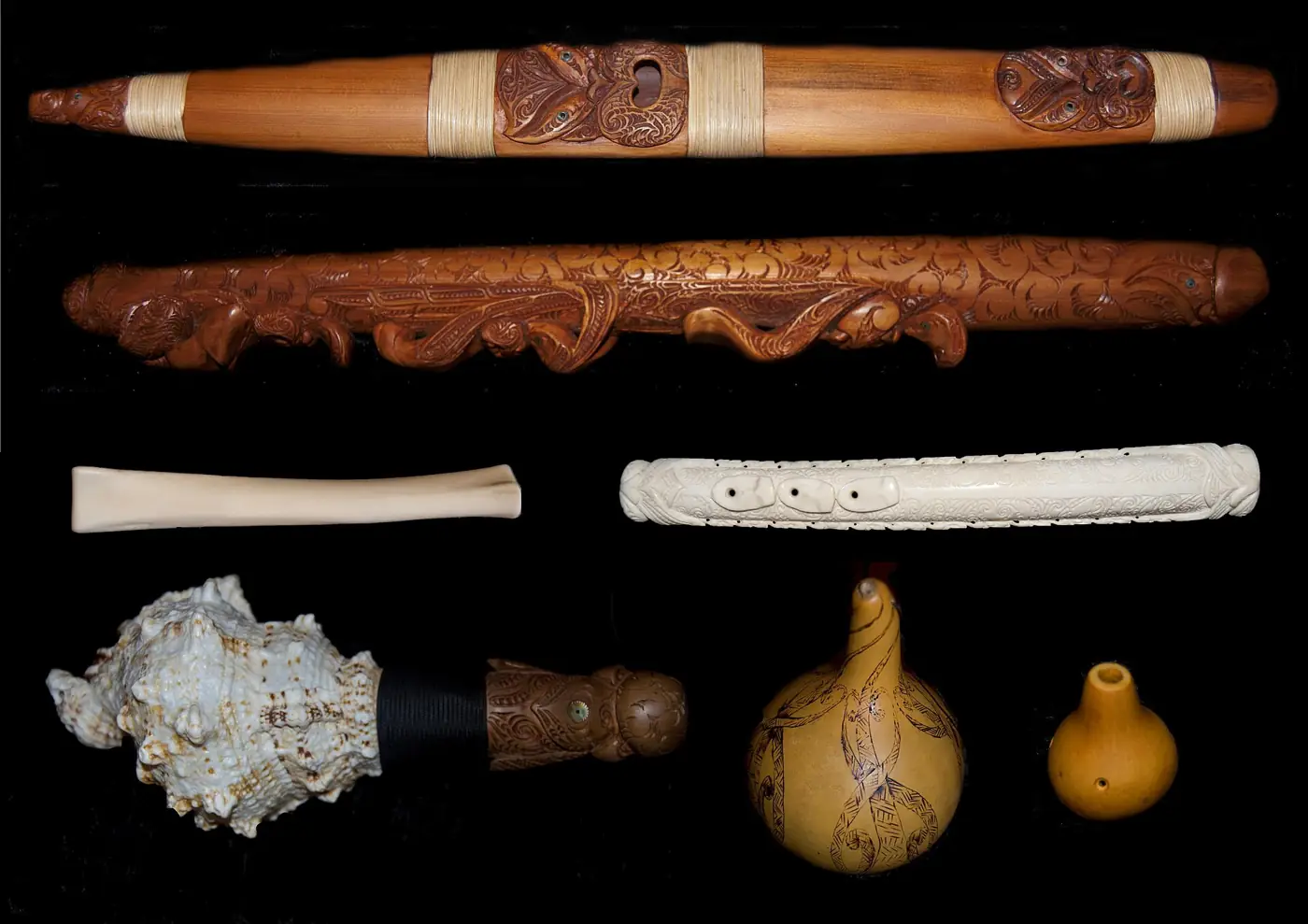
How action songs grew, and the instruments (including ukulele) that accompanied them.
Respond
Pacific churches in New Zealand ↗Te Ara
The churches at the heart of Pacific community life and choir singing.
Experiment
Chrome Music Lab: Song Maker ↗Google
Try melodies over a bass line and hear how the harmony changes, in the browser.
Experiment
Lessons ↗musictheory.net
Clear, free lessons on notes, intervals and chords.
Arrange
Round (music) ↗Wikipedia
How rounds work, with examples from around the world.
Transform
Events ↗NZ Choral Federation
Choir festivals and workshops across Aotearoa: see what young singers work towards.
Exhibit
The Arts in Year 7 ↗Ministry of Education
What whānau can expect their child to learn in music, including singing in harmony.
Real audiences
- Whānau and the school community at an assembly or whānau evening
- Residents of a local rest home or a seniors' group, who join in the last chorus
- A Pacific language week or cultural celebration at school
Work with other schools
- Learn the same round with a partner school and combine the parts in a joint recording, with each school singing different entries.
- Swap recordings with a school in a different setting (urban and rural, or Aotearoa and a Pacific nation), sharing a song from each community with the right permissions and a note about its meaning.
- Hold a combined 'community sing' where several schools perform one song each and everyone sings a round together at the end.
Stretch challenges
- Write your own round: a four-bar tune using C, E and G that works when a second group starts two bars later.
- Interview a choir member, church musician, kapa haka tutor or barbershop singer about how they learn their part and listen to others.
- Arrange a short song for ukulele, glockenspiel and voices, and teach it to a junior class.
- Compare two versions of the same song (for example a choir and a pop version) and explain how the harmony changes the mood.
New Zealand Curriculum
What this world covers
Mapped to the refreshed Phase 3 statements. The whole class covers both the Year 7 and Year 8 sequences over two years.
The Arts · Music
Elements of music: intervals (unison, 3rd, 5th) shape melody; major and minor tonality and mood; a pedal or drone can create harmony, and changing the drone changes the tonality; C major and A minor as tonal centres
Year 7 sequence
The Arts · Music
Singing in harmony in a range of traditions with a focus on phrasing, tuning and sensitive dynamics; singing rounds in three or four parts; posture, breathing and ensemble awareness
Year 7 sequence
The Arts · Music
Playing a melody alongside a bass line, first as a whole class then in smaller groups, using staff notation to support aural knowledge; presenting a performance that includes a music element from te ao Māori, such as percussive body sound, with guidance
Year 7 sequence
The Arts · Music
Listening and responding: music reflects cultural and historical contexts, including Māori and Pacific traditions; comparing how different traditions (choral, Pacific church, barbershop, waiata-ā-ringa) use harmony
Year 7 sequence
The Arts · Music
Participating in ensemble performances, maintaining balance and blend; playing chords on an instrument (ukulele C, Am, F, G7)
Year 8 sequence
English · Oral language
Roles in group discussion during rehearsal feedback circles, and a short spoken introduction for a real audience
Year 7 sequence
For teachers: how to run it
Prep: book the music room or hall for at least one session a week, gather ukulele (one between two at minimum; tune them to G–C–E–A before each session or use a clip-on tuner), a keyboard or two, any tuned percussion (xylophones, glockenspiels, chime bars), and a speaker for listening. Print chord cards for C, Am, F and G7, and a large lyric-and-part chart for each song. Choose repertoire that is out of copyright or clearly licensed for school performance: traditional rounds ('Frère Jacques', 'Dona nobis pacem', 'Viva la musica'), folk songs, hymns in the public domain, or songs your school already performs with the right licence (check the school's APRA AMCOS licence for performance of copyright songs). Collect listening extracts for week 1: a school or youth choir in four-part harmony, a Samoan or Tongan church choir, a barbershop quartet, and a waiata-ā-ringa accompanied by guitar. Voice care: every session begins with a posture, breath and gentle voice warm-up, never with loud singing; students sip water and never shout or strain; some students' voices are changing at this age, so let them choose the part that sits comfortably and never single anyone out to sing alone unless they volunteer. Ukulele: fingertips get sore at first, so keep early playing to 10–15 minutes and teach a light touch. Hygiene: no sharing of wind instruments. Cultural protocols: waiata, haka and karakia carry whakapapa, meaning and tapu. Teach or perform a waiata only with the guidance and permission of the school's kapa haka tutor, kaumātua or iwi partner, who can explain its meaning, its tikanga and the right occasion for it; do not rearrange a waiata or add harmony parts to it without that permission. The curriculum's 'music element from te ao Māori' (such as a percussive body sound like the stamps and slaps in haka waiata) should be taught by, or checked with, that person, and used respectfully rather than as a gimmick. The same care applies to Pacific hymns and songs: invite community members, acknowledge them properly (kai, koha, a thank-you performance or letter), and let them lead. For a rest-home visit, contact the facility early, check access and health requirements, and prepare students for residents who may be frail or living with dementia. Differentiation: supported learners sing the melody or play a one-chord or drone part (C and G on a xylophone), then add a second chord; confident learners sing the harmony line, play a moving bass line, or lead a section of the round. Every student has a part, and non-singing roles (conductor, count-in leader, stage manager, sound recorder) are available alongside, not instead of, ensemble music-making. Feedback uses 'I notice… I wonder… What if…' and focuses on the sound of the group, never on individual voices; there are no auditions, rankings or solos by pressure. Pīwakawaka, the AI companion, asks one question about the ensemble's balance or a musical choice; it never chooses parts, arranges the music or judges the performance. Kōkiri Lab links: the listening, turn-taking and collective effort in ensemble work connect to Kōkiri Lab's wellbeing and hauora learning, and to the collaboration skills used across its project worlds.
Plan this world into any term with the two-year planner. Students can record their thinking in their Kōkiri Learn portfolio.
More Arts worlds

Ready to run it with your class?
Free trial for NZ schools. One combined Years 7–8 class, any term.