Session 1 · SOLVE: See the Pattern
Pattern hunt
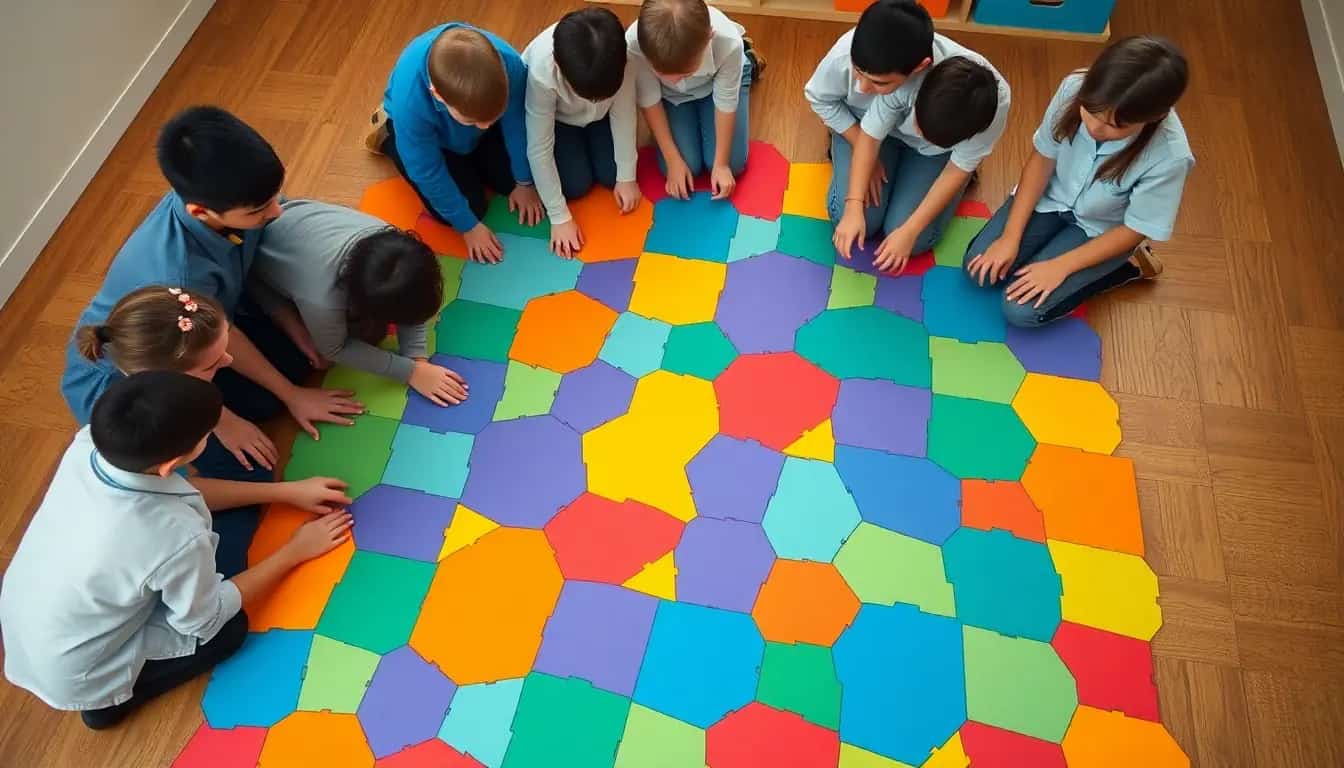
- 10 minHook: show a photo of honeycomb, a brick wall and a tiled floor. What is the same about all three? Introduce the word tessellation: shapes covering a surface with no gaps and no overlaps.
- 25 minShape safari around the school: photograph or sketch five repeating patterns (pavers, bricks, fences, windows, leaves). For each, record the shapes, how many meet at one corner and whether it is exactly the same everywhere.
- 10 minShare: which shapes appear most often? Why do you think builders like them?
- 5 minEvidence wall: write one question you want to answer this inquiry.
Session 2 · SOLVE: See the Pattern
Why 180°?
- 10 minSort a pile of paper triangles by their angles (acute, right, obtuse) and by their sides (equilateral, isosceles, scalene). Which combinations are impossible?
- 15 minTear the three corners off a paper triangle and line them up. What do they make? Try it with a very different triangle.
- 15 minMeasure the angles of three triangles with a protractor. Why do some sums come to 178° or 182°? What is the real answer, and how could we be sure?
- 10 minRead 'Angles, triangles and the 180° rule' (first half). Write the rule in your own words.
Getting started
Sort triangles by one property at a time before sorting by both.
Stretch
Draw a triangle and a line through one corner parallel to the opposite side. Use equal angles to explain why the three angles must add to 180°.
Checkpoint
Everyone can classify a triangle two ways and explain with the torn-corners model why its angles add to 180°.
Activities for this week
- Tear the corners: Do the angles of every triangle really add up to 180°?
- Shape safari: Where are tessellations hiding in our school and in nature?
Useful this week
- Tessellation ↗ Regular and semi-regular tessellations with clear pictures and an interactive tool.
- Triangles ↗ Types of triangles by sides and angles, and the 180° rule.