Session 1 · SOLVE: Organise Information
Angle sums from triangles
- 10 minDraw a quadrilateral, pentagon and hexagon. From one corner, draw lines to split each into triangles.
- 20 minFill a table: number of sides, number of triangles, angle sum. Look for the rule. Write it in words, then with letters: 180(n − 2).
- 10 minRegular polygons: divide the sum by the number of angles to find each interior angle (square 90°, hexagon 120°).
- 10 minExterior angles: walk around a large chalk pentagon on the court, turning at each corner. How far have you turned by the end?
Session 2 · SOLVE: Organise Information
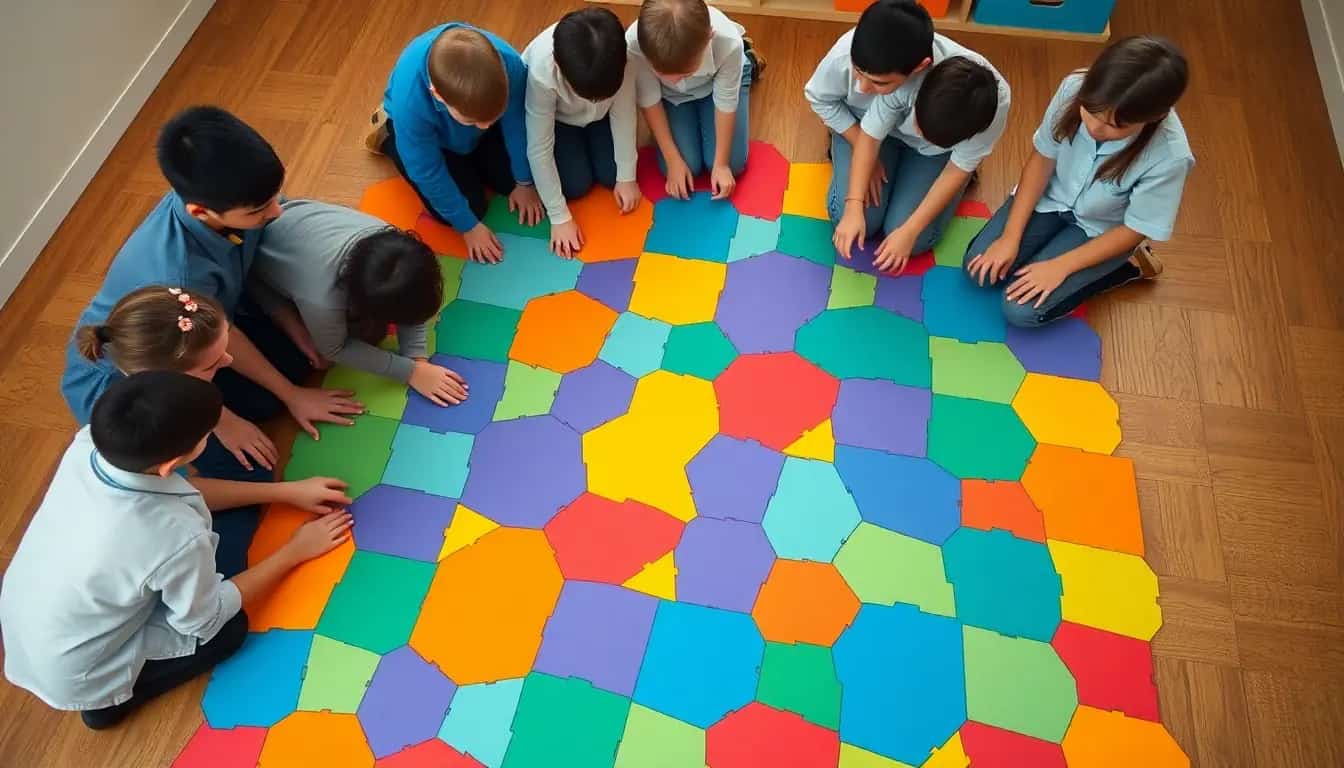
Will it tessellate?
- 10 minPrediction: which regular polygons will tile a floor with no gaps? Record your prediction and reason.
- 25 minTest with paper triangles, squares, pentagons, hexagons and octagons, all with the same side length. Record the angles that meet at one corner and whether they make exactly 360°.
- 10 minOrganise the results in a table. Why do only three regular polygons work on their own?
- 5 minMix and match: can octagons and squares work together? Check the corner: 135° + 135° + 90°.
Getting started
Use pre-cut shapes and a 360° corner card to test whether the corner angles fill the circle.
Stretch
Find all the ways to fill 360° with a mix of regular polygons. Mathematicians have found eight tile patterns (called semi-regular tessellations) that work everywhere.
Checkpoint
Students have a completed angle-sum table with the rule 180(n − 2)° and can explain why hexagons tessellate but pentagons don't.
Activities for this week
- Angle sums from triangles: Can we find the angle sum of any polygon without measuring?
- Will it tessellate?: Which regular polygons can cover a floor with no gaps on their own?
Useful this week
- Interior angles of polygons ↗ The triangle method for any polygon's angle sum, with a table to check your own.
- Transformations ↗ Translation, reflection, rotation and resizing explained with diagrams.