Session 1 · SOLVE: Link Ideas
Nibble tiles
- 10 minLook at an Escher-style tessellation. How did he turn a square into a lizard or a bird?
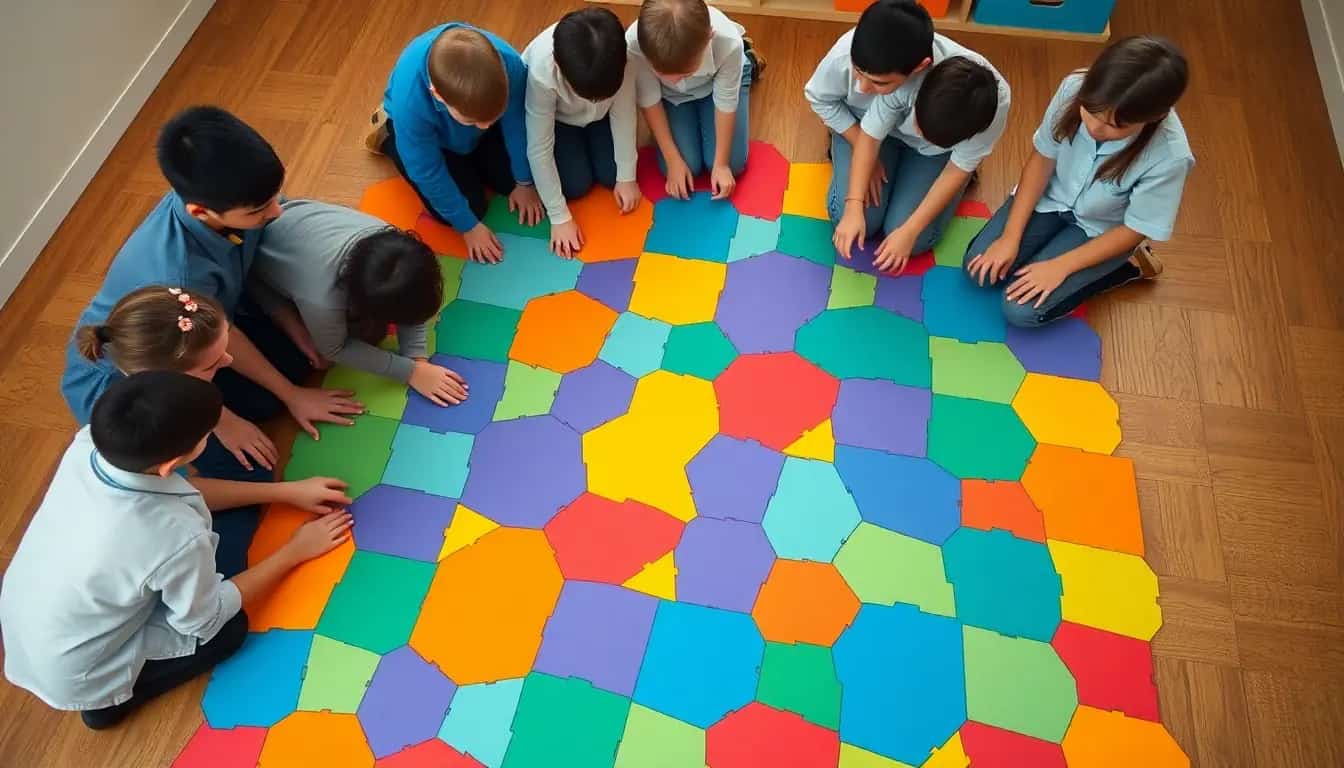
- 25 minMake a nibble tile: cut a shape from one side of a card square, translate it to the opposite side and tape it. Try a second pair of sides, or rotate a nibble about a corner or a midpoint.
- 15 minTrace your tile at least 12 times to see the pattern. Add your own motif and colour scheme.
Session 2 · SOLVE: Verify
Check the design
- 10 minTohu asks one question about your design: how do you know the pattern will never leave a gap?
- 20 minPeer check with a partner group: at every corner, do the angles add to 360°? Are there gaps or overlaps? Is the transformation described correctly? What symmetry does the pattern have?
- 15 minMeasure the real surface (path, wall or courtyard). Choose a tile size and work out how many tiles are needed using area.
- 5 minRecord the changes you need to make.
Getting started
Start with a translation-only nibble on one pair of sides; check it with tracing paper.
Stretch
Make a tile that uses a half-turn rotation about the midpoint of a side. Show where the centres of rotation are in your final pattern.
Checkpoint
Each student has an original tile that tessellates, a checked angle proof and a tile count for the real surface.
Activities for this week
- Nibble tile: How can we turn a plain square into a unique tile that still tessellates?
Useful this week
- Symmetry ↗ Reflection and rotational symmetry, for describing your pattern.
- Tāniko and tukutuku ↗ How tukutuku and tāniko are made, and the names and meanings of key designs.
- Pacific grassroots arts ↗ How Pacific artists in Aotearoa make and share tapa, tīvaevae and weaving.
- Symmetry gallery ↗ Escher's famous tessellations of birds, fish and lizards, to study his transformations.
- Polypad ↗ Free digital polygons and tiles to test whether your design leaves gaps.
- Resizing (enlargement) ↗ Scale factors and what they do to lengths and areas when you scale up.