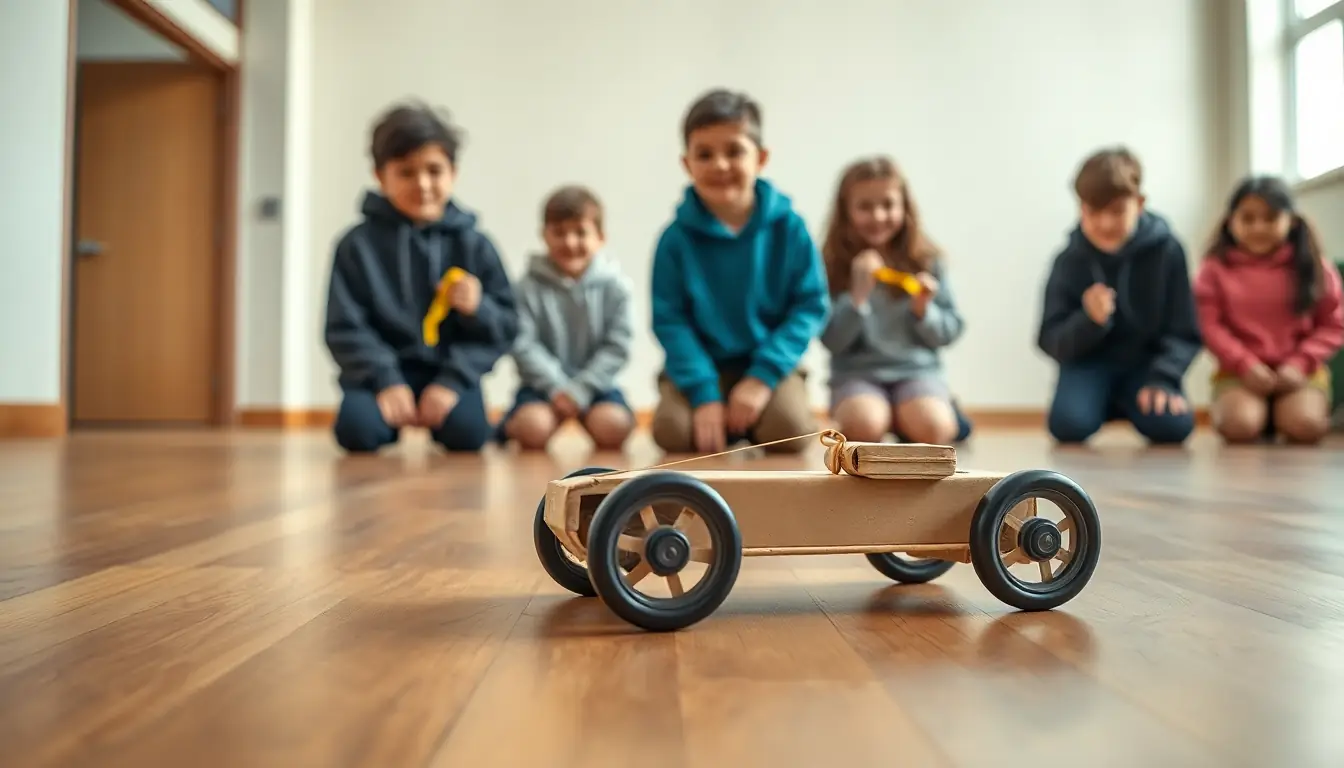
Session 1 · VOICE: Validate the Problem
The mystery car
- 5 minShow a ready-made elastic-band car without running it. Draw the T-chart: What I observe | What I infer.
- 10 minPairs observe the car for 60 seconds and record four observations. Then write an inference for each, with an arrow back to the observation.
- 10 minRun the car once. Thirty seconds of observations only. Compare with your inferences: which held up?
- 15 minLaunch the challenge: the junior class needs cars that travel as far as possible. What might affect distance? List every idea. Sort into things we can change and things we can measure.
- 10 minChoose a class focus question, for example: 'How do wheels, bands and surfaces change how far an elastic-band car travels?'
Session 2 · VOICE: Observe
Stretch, bend, squash
- 10 minForce arrows: every force is a push or a pull with a size and a direction. Draw arrows on pictures of a tug-of-war, a kicked ball and a person sitting on a chair.
- 25 minStations: stretch a rubber band and a spring, bend paper clips and thin and thick wire, squash plasticine and a sponge. Does each one go back to its shape (elastic) or stay changed (plastic)? Name the internal force: tension (stretching) or compression (squashing).
- 15 minMake a rubber-band force meter from a cup, a paper clip hook and a ruler. Calibrate it with bags of 100 g, 200 g and 300 g of rice.
Getting started
Use the observation/inference sentence starters: 'I can see…' and 'I think this means… because I saw…'.
Stretch
Find the point where a paper clip stops springing back. How many degrees can it bend before the change becomes permanent?
Checkpoint
Everyone can sort an example into elastic or plastic change and draw a force arrow with a direction.
Activities for this week
- Make a force meter: How can you measure a push or a pull?
- Elastic or plastic?: Which materials spring back, and which stay changed?
Useful this week
- Physical World – forces ↗ The big ideas about forces, pushes and pulls in one place.
- Friction – the contact force that slows or stops moving objects ↗ Friction ideas, NZ contexts and hands-on activities.