Session 1 · SOLVE: Link Ideas
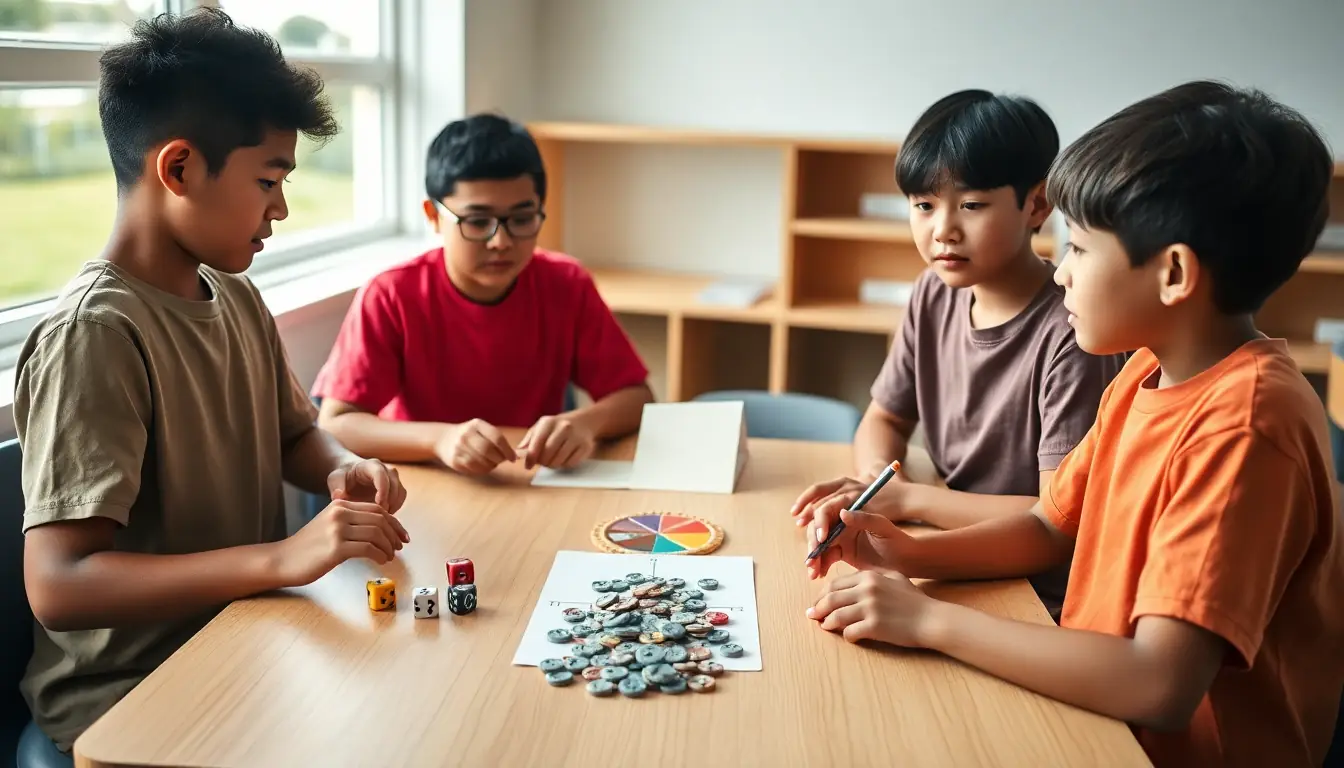
The dice race
- 10 minSet up a race: 11 horses numbered 2 to 12. Roll two dice; the horse with that sum moves one step. Each person picks a horse.
- 20 minRun three races. Record the winners.
- 15 minLink: compare the winners with your two-dice table. Why does 7 win so often and 2 and 12 hardly move?
- 5 minPredict the probability of rolling a sum of 7 and of not rolling a 7.
Session 2 · SOLVE: Link Ideas
Complements and spinners
- 10 minComplementary events: P(event) + P(not the event) = 1. Try it on the dice race.
- 20 minSpinner design: make a spinner where blue has a 1/4 chance, red 1/3 and green the rest. What angle does each sector need? (Hint: 360° × the probability.)
- 15 minSpin 30 times and compare with the theory. Pool with another group for 60 spins.
- 5 minPaper cup toss: predict whether a cup lands upright, upside down or on its side. Can you work out its probability without experimenting?
Getting started
Use a spinner with four equal sectors first, then change the sizes.
Stretch
What is the probability of rolling at least one six when you roll two dice? Use the complement to find it quickly.
Checkpoint
Students can explain why experimental results differ from theoretical probability, and use complements to find a probability.
Activities for this week
- The two-dice race: Why do some totals come up far more often than others?
- Spinner sector angles: How do you build a spinner with exactly the chances you want?
- The paper cup drop: What is the chance of a cup landing upright, upside down or on its side, when theory can't tell you?
Useful this week
- Probability: types of events ↗ Complementary, independent and mutually exclusive events explained with examples.
- Quincunx (Galton board) ↗ An interactive Galton board to see random bounces build a predictable shape.