The Arts · World 3 of 8 · Years 7–8
Move: Dance and Choreography
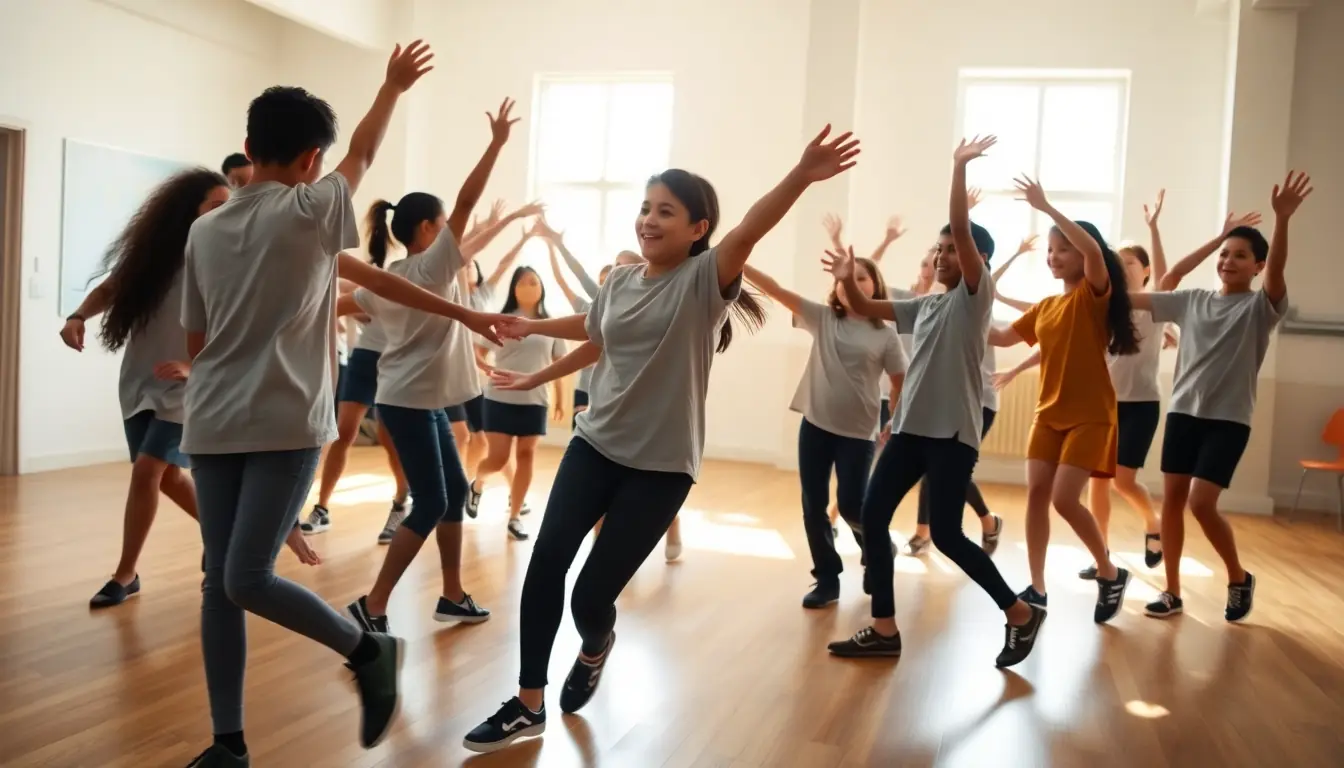
No words, just bodies. Build a group dance from your own moves that makes an audience feel something, then perform it live.
Big question: How can a group of bodies moving together tell a story that an audience understands and feels, without a single word?
- You'll make
- A 2–3 minute original group dance (four to six dancers) built from your own motifs, with a clear beginning, middle and end, planned transitions, and one deliberate choice of costume colour, prop, lighting or sound. You also keep a choreographer's score (a page of drawings, floor patterns and notes) and give a 30-second spoken introduction before you perform.
- For
- Whānau and the school community at an end-of-term showcase, assembly or community evening
- Time
- 5 weeks · 2 sessions a week
Your mission
Why it matters
Your school's end-of-term celebration (or a local Matariki evening) has a three-minute gap in the programme, and your class has been asked to fill it with an original group dance. There is no teacher-made routine to copy: you will invent the movement yourselves, shape it into a piece with a beginning, middle and end, and perform it for whānau. Along the way you will learn from Aotearoa's dancers, from kapa haka and siva to contemporary and hip hop crews.
Dance is one of the oldest ways people have told stories, welcomed guests, grieved and celebrated. In Aotearoa, the haka master Henare Teowai said 'Kia kōrero te katoa o te tinana': the whole body should speak. When you understand how choreographers use space, timing, energy and symbols, you watch everything from a kapa haka bracket to a music video with sharper eyes. You also learn to create with other people, to give and take feedback, and to stand in front of an audience with confidence.
Your first step
Pick one feeling or idea (for example: flooding, belonging, a crowded bus, a long journey). Make three gestures that show it, each one bigger than feels normal. Then perform them slow, then fast. Which version carries the idea better?
Make it yours
Choose a context
Same big question, three different places to explore it. Pick the one that fits your class and community.
Our awa and whenua: dancing a place
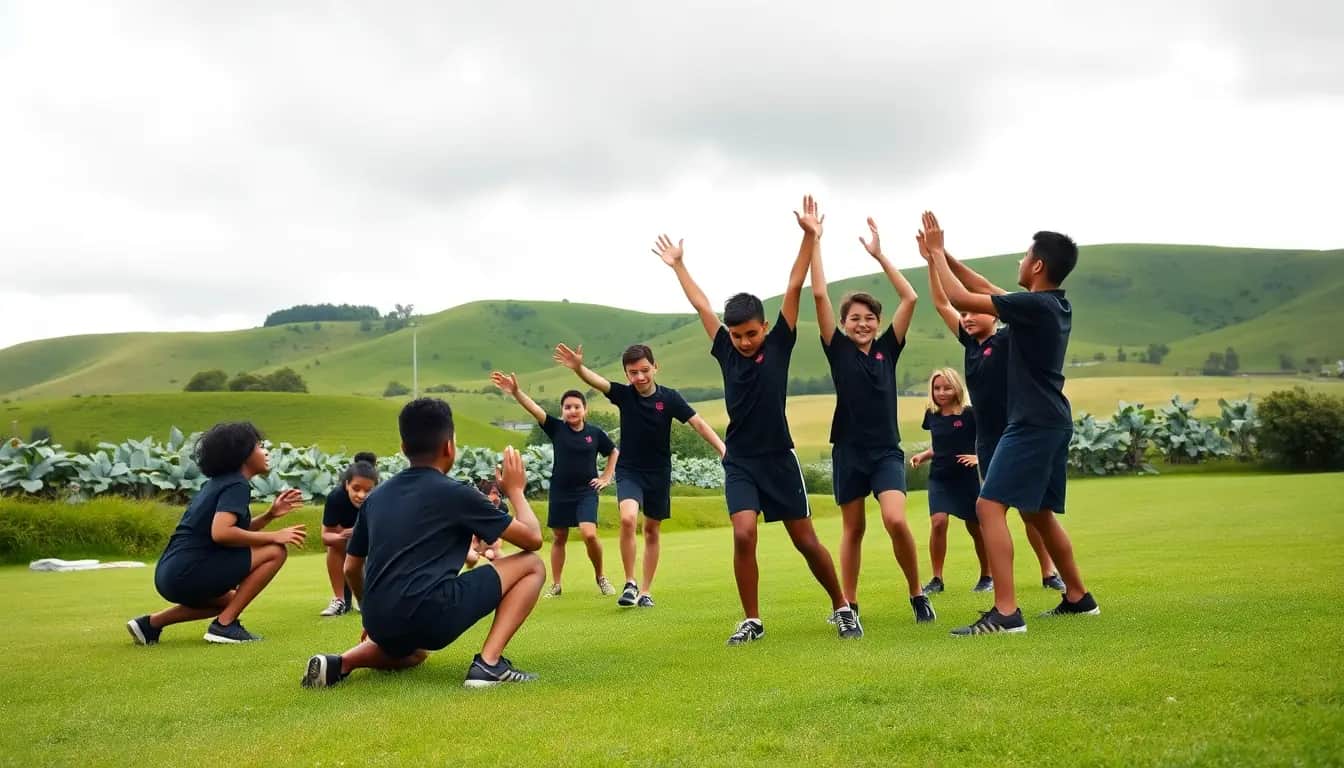
A river after heavy rain, a beach at low tide, wind across a paddock, a maunga you see every day. Visit or photograph the place, record its sounds, and notice its shapes and rhythms: how water curls, how tī kōuka bend, how waves arrive in canon. Build a dance that shows how the place moves and changes. If the place carries local stories, learn them through mana whenua and the school's iwi relationships, and create your own movements rather than borrowing sacred ones.
Streets and city: urban movement
A crowded bus stop, a skate park, the school gate at 3 pm, a night market, a rugby sideline. Film everyday movement (hands and feet, not faces), then exaggerate and repeat it until it becomes dance. Learn how hip hop grew in Aotearoa from the 1980s bop crews to Parris Goebel's world-winning choreography, and how street dance and contemporary dance borrow from daily life.
Voyaging and belonging: journeys to Aotearoa
Many families in your class have arrived from somewhere: from Sāmoa, Tonga, the Cook Islands, India, China, the Philippines or Britain, or by waka centuries ago. Collect a journey story you are allowed to share from your own whānau and turn it into a dance about leaving, travelling, arriving and belonging. Study how siva Sāmoa and kapa haka tell stories through movement, and invite community members to share their knowledge, but create your own movement vocabulary.
CREATE
Week by week
Two sessions a week, each with Getting started and Stretch support so the whole class works together.
- W1Bodies that speak: the dance elements and how cultures tell stories through movementConnect: The whole body should speak · Respond: Watching like a choreographer
- W2From everyday gesture to dance motifExperiment: Gesture to motif · Experiment: Levels, pathways and symbols
- W3Arrange the dance: structure, devices and musicArrange: Choreographic devices · Arrange: Beginning, middle, end
- W4Transform the dance: transitions, feedback and performance technologiesTransform: Smooth transitions and honest feedback · Transform: Costume, prop, light and sound
- W5Exhibit: perform for a real audience and reflectExhibit: Dress rehearsal · Exhibit: Performance and reflection
Hands-on
Activities
Investigations and projects that fit the weeks above. Open one to see what you need and how you'll know it worked.
Elements shuffleHow many ways can one simple walk change?Open
You need: a clear space · a drum, tambourine or clapping sticks · a list of the five dance elements
- Walk around the space, filling the gaps. No talking.
- When the drum sounds, the leader calls one change: a new body part leads (elbow, knee, head), a new level (low, middle, high), a new pathway (curved, zigzag), a new speed, or a new energy (sharp, smooth, heavy, light).
- Add relationships: meet a partner and mirror them, then move away and move towards them.
- Freeze on the final drum beat in a shape that shows how you feel right now.
- In pairs, name which element changed the feeling of the walk the most.
How you'll know: You can name body, space, time, energy and relationships and show each one in movement.
Safety: Clear bags and chairs; walk, don't run; keep one arm's length from other dancers.
Go further: Lead a round yourself and combine two changes at once (for example, low and sharp).
Fits week 1 →See, think, wonder: watching cultural dance with respectWhat can we learn from how kapa haka and siva Sāmoa tell stories?Open
You need: a recorded kapa haka performance and a siva Sāmoa or other Pacific dance item · a three-column page: See / Think / Wonder
- Watch once just to enjoy it. No writing.
- Watch again and write only what you see: formations, hand movements, footwork, facial expressions, the leader's role, how performers enter and exit.
- Write what you think the movements might mean, with a clue for each idea.
- Write questions you would need to ask someone from that culture to understand it properly.
- Compare with a partner: which conventions did both forms share (unison, strong lines, a leader, storytelling hands)?
How you'll know: Your notes separate what you can see from what you are guessing, and your questions show respect for the knowledge-holders.
Go further: Read about ihi, wehi and wana on Te Ara. Where did you feel each one in the performance?
Fits week 1 →Gesture to motifHow does an everyday action become dance?Open
You need: a partner or small group · your idea sentence · a device to film hands and feet (optional)
- Choose an everyday gesture that links to your idea, such as shading your eyes, rowing, waving, sweeping, or wiping rain away.
- Perform it normally three times so the group can see it.
- Change the size: make it tiny, then huge.
- Change the speed: slow motion, then very sharp.
- Change the level or body part: do it lying down, or with your foot instead of your hand.
- Keep the version that feels most like dance but still carries the idea. That is your motif.
How you'll know: Someone watching can still guess the original gesture or idea, but it now looks like dance.
Safety: Warm up first; take care with sudden, sharp movements of the neck and back.
Go further: Add a sound (a breath, a stamp, a clap) to your motif and use it as a signal for the group.
Fits week 2 →Floor-pattern mappingWhere does each dancer travel, and why?Open
You need: A3 paper and coloured pens · masking tape in three or four colours · a clear floor
- Draw the performance space from above. Mark where the audience sits.
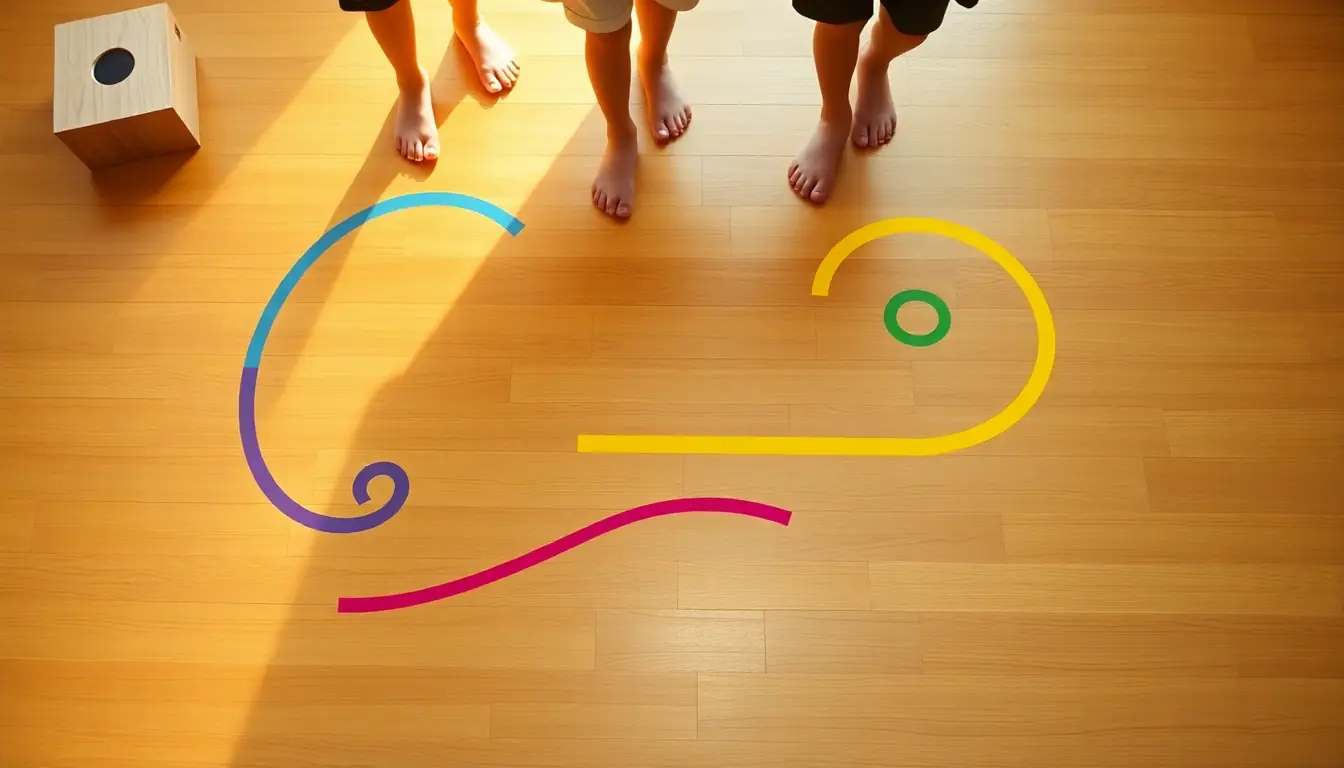
- Draw each dancer's pathway in a different colour: straight lines feel direct and strong, curves feel gentle or flowing, zigzags feel unsettled.
- Tape the main pathways onto the floor.
- Walk the pathways slowly, then at performance speed, checking for collisions.
- Adjust so the strongest moment happens closest to the audience or in the centre.
How you'll know: Every dancer can walk their pathway without looking at the tape by the end of the session.
Safety: Remove the tape afterwards so no one slips.
Go further: Design a pathway shaped like something connected to your idea (a river, a spiral, a waka route).
Fits week 2 →Canon, unison and mirrorHow do choreographers make a group of dancers look like one living thing?Open
You need: your group's motifs · a steady beat (drum or music) · a notation page
- Perform motif 1 in unison, all dancers together, all facing the same way.
- Perform it in canon: dancer 1 starts, dancer 2 starts two counts later, and so on.
- Pair up and perform motif 2 as a mirror, facing each other.
- Try a formation change: from a straight line to a circle to a cluster.
- Choose which device suits each part of your idea and write it in the score.
How you'll know: Your group can switch between unison and canon on a signal and explain why each fits the idea.
Go further: Try 'accumulation': dancer 1 performs one move, then dancers 1 and 2 perform two moves, and so on.
Fits week 3 →Transitions workshopHow do you get from one section to the next without the dance switching off?Open
You need: a film of your rough run · your score · the performance space
- Watch the film and mark every moment where a dancer walks, waits or looks around.
- For each gap, choose a linking movement: a roll, a turn, a travelling step, a slow walk in character, or a freeze that becomes the next shape.
- Rehearse only the transitions, one after another.
- Run the whole dance and film it again.
- Compare the two films. Where does the energy now flow?
How you'll know: The dance has no dead moments, and the transitions help the mood change the way you intended.
Safety: Practise rolls on a mat first and roll across the back of the shoulder, never over the neck.
Go further: Use a transition to change the mood deliberately, for example a long stillness before the climax.
Fits week 4 →A prop that changes meaningCan one object, colour or light change what the audience sees?Open
You need: one prop per group (a length of fabric, a chair, a torch, a bowl, a stone) · a light switch or lamp · your dance
- Perform one section of the dance without the prop.
- Perform it again with the prop. How does the meaning change? (A blue fabric could become a river, a flag or a wave.)
- Try one lighting change: full light, then only a torch or one lamp.
- Ask an audience of two: which version told the idea best?
- Keep only what adds meaning. Cut what distracts.
How you'll know: You can explain in one sentence why your chosen prop, costume colour or light supports the idea.
Safety: Fabric stays below shoulder height when dancers travel; torches are never shone into eyes.
Go further: Design a simple lighting cue sheet: which light, on which count, and why.
Fits week 4 →Choreographer's scoreHow do dancers remember and share a dance?Open
You need: an A3 page or visual diary · pencils and coloured pens · your motifs and floor patterns
- Draw each motif as a stick-figure sequence of three or four frames.
- Add arrows for direction and symbols for energy (a wavy line for smooth, a spike for sharp).
- Write counts under each motif (for example: 1–8, 1–8).
- Add the floor pattern and the order of sections.
- Give the score to someone from another group. Can they perform one motif from it?
How you'll know: Another student can read your score and reproduce at least one motif without being shown.
Go further: Research Laban notation, a system used to write dances down, and try one symbol.
Fits week 3 →Look closer
From the real world
Background reading
Read to understand
Short readings written for Kōkiri Learn students, with their sources.
- The dancer's toolkit: body, space, time, energy and relationshipsThe five elements every choreographer uses, and how changing just one of them changes what a movement means.
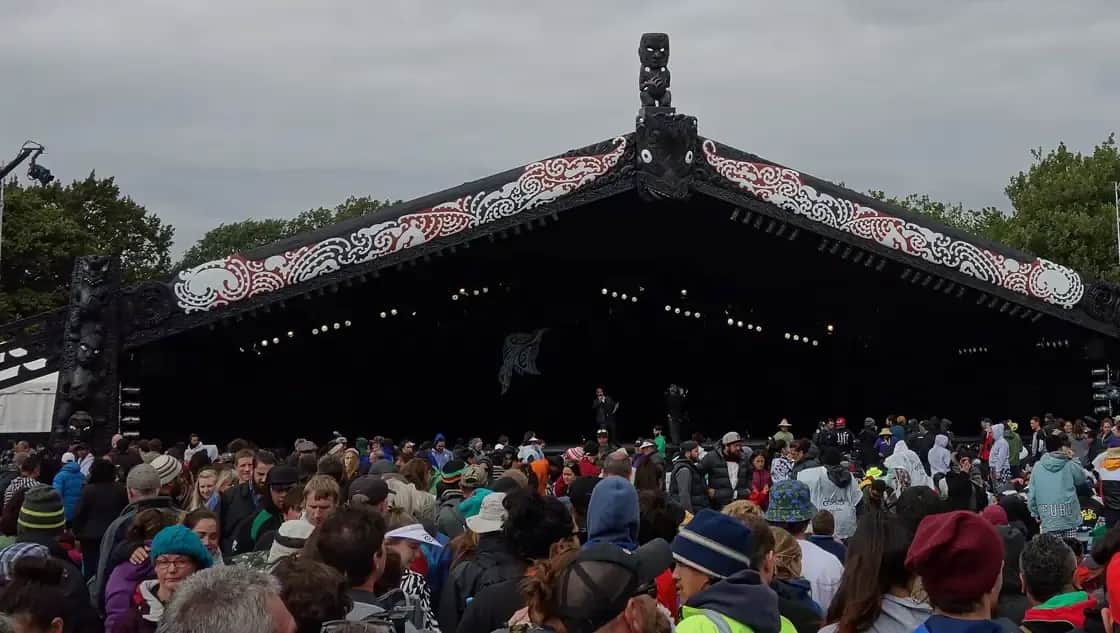
- Kapa haka, siva and more: learning from cultural dance with respectHow kapa haka and Pacific dance forms tell stories, what festivals like Te Matatini and Polyfest are, and how to learn from cultural dance respectfully.
- From moves to a dance: how choreographers build a pieceMotifs, devices, structure and transitions: the steps choreographers in Aotearoa use to turn movement ideas into a finished dance.
Trusted NZ sites
Explore more
Placed at the stage of the journey where each one helps.
Connect
Kapa haka ↗Te Ara
What kapa haka is, its six disciplines, and the story of Te Matatini.
Respond
Cultural dance ↗Te Ara
Pacific dance in Aotearoa, Polyfest and the Pasifika Festival.
Respond
The Dance Collection ↗NZ On Screen
New Zealand dance on film, from ballet to hip hop, to watch and discuss.
Respond
Contemporary dance ↗Te Ara
How Māori and Pacific choreographers shaped New Zealand contemporary dance.
Experiment
Touch Compass ↗Touch Compass
New Zealand's inclusive dance company: ideas for movement every body can do.
Arrange
Black Grace ↗Black Grace
Neil Ieremia's company blends Pacific and contemporary dance to tell stories.
Transform
Pacific Dance New Zealand ↗Pacific Dance NZ
Pacific choreographers making new work that honours culture.
Exhibit
Development and resources ↗Creative New Zealand
How New Zealand supports artists and dance makers to share their work.
Exhibit
The Arts in Year 8 ↗Ministry of Education
What whānau can expect their child to learn in the performing arts.
Real audiences
- Whānau and the school community at an end-of-term showcase or assembly
- A local Matariki, Pasifika or community festival stage, if the organisers welcome school items
- A junior class, who try one motif themselves after watching
Work with other schools
- Swap dance films with a partner school in a different setting (city and rural, or Aotearoa and a Pacific nation) on the same theme, and send back 'I notice… I wonder…' responses.
- Each class choreographs one section of a combined piece on a shared theme; rehearse to the same music and film the sections together.
- Invite a professional dancer or a kapa haka tutor to give live-streamed feedback to several schools at once.
Stretch challenges
- Choreograph a 30-second solo that expresses the same idea as the group dance but from one character's point of view.
- Interview a kapa haka tutor, a Pacific dance leader or a dance teacher about how they create or learn new items, and share what you learned.
- Create a dance film: perform your piece outdoors in the place it is about and edit it to music, using close-ups of hands and feet.
- Adapt your dance so it can be performed seated, then teach it to a group of younger students.
New Zealand Curriculum
What this world covers
Mapped to the refreshed Phase 3 statements. The whole class covers both the Year 7 and Year 8 sequences over two years.
The Arts · Performing arts (dance and drama)
Using symbolic gesture and abstraction to express themes; building on body, space, time, energy and relationship to create more complex performances; refining choreography for expressive clarity
Year 7 sequence
The Arts · Performing arts (dance and drama)
Exploring how kapa haka uses structural conventions (waiata, haka, poi) to convey cultural narratives, expressed through ihi, wehi and wana; identifying features unique to a style or genre
Year 7 sequence
The Arts · Performing arts (dance and drama)
Using transitions to shape the emotional flow of a performance; intentionally using lighting, sound and costume; recognising the role of reciprocity in kapa haka and siva Sāmoa
Year 8 sequence
The Arts · Music
Tempo, dynamics, metre and rhythm linked to their effect on the listener and the dancer (choosing and cutting music for the dance)
Year 7 sequence
Health and Physical Education · PE: movement skills
Refining movement skills, warm-up and cool-down, and working cooperatively in a group to create and perform a sequence
Year 7 sequence
English · Oral language
A short spoken introduction to a performance for a real audience, using clear, purposeful language
Year 8 sequence
For teachers: how to run it
Prep: book the hall or a clear space for at least one session a week, plus a speaker, a drum or clapping sticks, masking tape in four colours, A3 paper for choreographers' scores, and a device for filming (hands, feet and group shapes, not close-up faces; check media consent before anything is shared). Collect two or three recorded performances for week 1: a kapa haka bracket (NZ On Screen and Te Matatini publish recordings), a siva Sāmoa or other Pacific item from Polyfest or the Pasifika Festival, and a contemporary work by Black Grace or Touch Compass. Safety: every session starts with a 5–8 minute warm-up (pulse raiser, joint rotations, stretches) and ends with a cool-down; check the floor for splinters and water if dancers are barefoot; no lifts above waist height and no throwing or catching of dancers; teach safe floor work (rolling through the back of the shoulder, not the neck). Cultural protocols: kapa haka and haka carry whakapapa, mana and tapu. Students learn about their structure, purpose and the values of ihi, wehi and wana, but they do not perform a haka or waiata-ā-ringa casually or invent a 'haka'. If the school has a kapa haka tutor or iwi partner, invite them to talk about tikanga and, if they offer, to teach something properly. The same applies to siva Sāmoa and other Pacific forms: invite a parent, church or community group, acknowledge them properly (manaakitanga and reciprocity: offer kai or a koha, and a thank-you performance or letter). Students then create their own movement vocabulary, inspired by what they learned but not copied from it. Inclusion: every element can be done seated or with one part of the body; see Touch Compass for inclusive choreography; offer non-performing roles (lighting, sound, filming, stage manager) for students who are anxious, while still having them help create movement. Differentiation: supported learners work from a motif bank on cards and a four-part structure template; confident learners add a second motif, use canon in three parts, or choreograph a solo within the group piece. Critique uses 'I notice… I wonder… What if…' and focuses on the dance, never on bodies or appearance; there are no rankings. Pīwakawaka, the AI companion, asks one question about a choreographic choice; it never makes or judges the dance. Kōkiri Lab links: the same explore–trial–feedback–refine loop runs through Kōkiri Lab's design and wellbeing worlds, and the warm-ups link to Health and PE movement learning.
Plan this world into any term with the two-year planner. Students can record their thinking in their Kōkiri Learn portfolio.
More Arts worlds
Ready to run it with your class?
Free trial for NZ schools. One combined Years 7–8 class, any term.