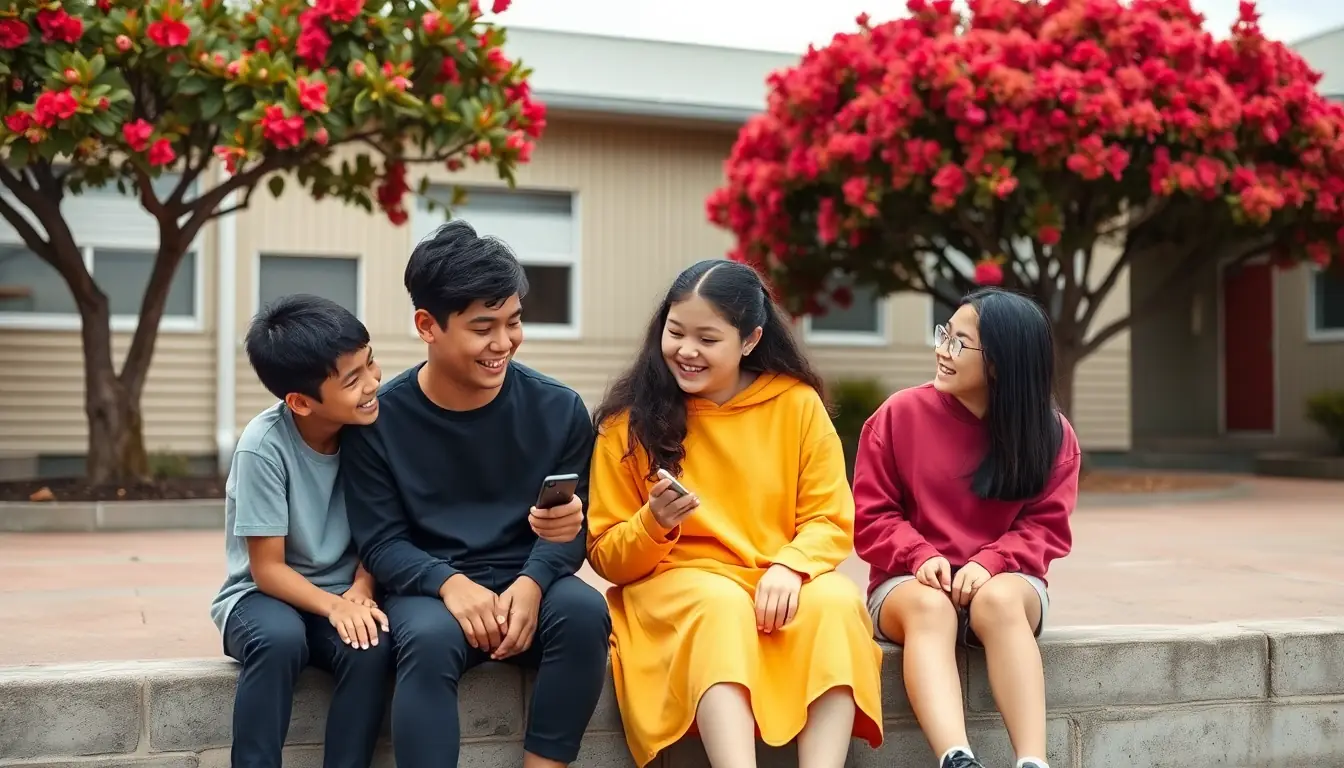
Health and Physical Education · World 5 of 8 · Years 7–8
Kind Online, Strong Offline
Group chats, feeds and filters: learn how the online world really works, then build a toolkit that helps younger kids stay kind and safe.
Big question: How can we look after ourselves and each other when so much of our friendship happens online?
- You'll make
- A 'Kind Online, Strong Offline' toolkit for a younger class: scenario cards, an upstander flowchart, a one-page guide to feeds and filters, and a short workshop your group runs for them.
- For
- A buddy class of younger students, whānau at a learning evening, and the school's wellbeing or student leadership team
- Time
- 5 weeks · 2 sessions a week
Your mission
Why it matters
A joke in a class group chat gets screenshotted, shared and seen by people it was never meant for. By Monday two friends aren't talking, one person has left the chat, and nobody is quite sure how it went so far so fast. Your job is to work out what happened, why it happens, and what anyone could have done differently, then build a toolkit that helps a younger class handle the same moments.
Most of you will have a phone, a gaming account or a group chat soon, if you don't already. Knowing how posts spread, how feeds decide what you see, how to say no clearly and how to back someone up helps you keep friendships strong and stay safe, online and off.

Your first step
Squeeze a little toothpaste onto a plate, then try to put it back in the tube. That is what posting online is like. Talk about one time a message, photo or joke travelled further than someone expected (no real names).
Make it yours
Choose a context
Same big question, three different places to explore it. Pick the one that fits your class and community.
The group chat and the gaming lobby
Where most everyday online friendship happens: class chats, voice chat in games, shared photos from the weekend. Use made-up characters and scenarios based on the kinds of things that happen, never real people, and follow how one message moves from friend to friend to strangers.
The team and the club
A rural netball, rugby league, waka ama or kapa haka group whose members stay in touch through a team chat and share photos after events. Explore team photo permission, jokes that go too far in the changing room and online, and stereotypes about who 'should' play which sport.
Whānau and the wider world
Families spread across Aotearoa, Samoa, Tonga, Australia and beyond keep in touch through video calls and shared albums. Explore asking before you share someone else's photo, respecting cultural values (in te ao Māori the head is tapu), and how influencers and ads from around the world land in your feed.
THRIVE
Week by week
Two sessions a week, each with Getting started and Stretch support so the whole class works together.
- W1Tune in: how friendships work online and offTune In: The toothpaste test · Tune In: Footprints that don't wash away
- W2Feeds, filters and online habitsHabits: Be the algorithm · Relationships: Banter or bullying?
- W3Boundaries, your voice and the right to change your mindRelationships: Passive, aggressive, assertive · Improve: Under pressure
- W4Filters, stereotypes and speaking upImprove: Filter detective · Value: Stereotype audit and the upstander
- W5Build the toolkit and run the workshopValue: Make the toolkit · Evaluate: Workshop and reflection

Hands-on
Activities
Investigations and projects that fit the weeks above. Open one to see what you need and how you'll know it worked.
Where did it go?How far can one message travel?Open
You need: a ball of wool or string · paper footprint cut-outs · a made-up message written on a card · sticky notes
- Sit in a circle. The first person holds the wool and reads the made-up message.
- They 'send' it to a friend by passing the wool while holding on to the end. That friend 'screenshots' it and passes it on.
- Keep going for eight passes. Each person writes on a sticky note who they are (friend, friend's cousin, stranger, future employer).
- Now try to 'unsend' it: can you wind the wool back without everyone letting go?
- Lay footprints along the path to show the trail the message left.
How you'll know: You can explain persistence, visibility, spreadability and searchability using your own web of wool.
Go further: Work out how many people could see it after five passes if each person shows three more.
Fits week 1 →Be the algorithmHow does a feed decide what to show you?Open
You need: a deck of about 80 content cards in five categories (sport, animals, gaming, food, music) with a coloured corner for each · a feed sheet for each student · the teacher as 'the algorithm'
- Each student gets five random cards: their first feed.
- Mark the cards you would 'like', 'watch to the end' or 'scroll past'.
- The algorithm (the teacher) collects the sheets and deals your next five cards, giving you more of the categories you engaged with.
- Repeat for five rounds and record how many of each category you get each round.
- Compare feeds: who ended up with only one or two categories? What did you stop seeing?
How you'll know: You can explain that feeds learn from clicks, likes and watch time, and why that can narrow what you see.
Go further: Add a 'sponsored' card the algorithm must slip in every round. How does advertising change the feed?
Fits week 2 →The banter lineWhen does a joke stop being a joke?Open
You need: a long rope or tape line on the floor · scenario cards (made-up names) · two end signs: 'friendly banter' and 'bullying'
- Read each card aloud and place it along the line.
- Use Netsafe's signs to argue your position: Is only one person laughing? Does it shame someone? Is it about their identity? Does it keep happening?
- Move a card if someone gives a strong reason.
- Pick the three hardest cards and write what someone could say or do in each.
How you'll know: You can give reasons for where a card goes, and name clues that a joke has crossed a line.
Go further: Rewrite one bullying card so the same group has fun without anyone being the target.
Fits week 2 →Ask first, accept the answerHow do we ask permission clearly, and respect a 'no' or a change of mind?Open
You need: scenario cards: borrowing a hoodie, posting a group photo, adding someone to a chat, joining a game, touching someone's hair · a phrase bank · an observer checklist
- In threes, choose roles: asker, answerer and observer.
- The asker asks clearly. The answerer says yes, no or 'not sure'.
- Replay with a twist: the answerer changes their mind partway through ('Actually, please don't post it').
- The asker practises accepting it: 'No worries, I'll delete it.'
- The observer ticks the checklist: clear ask, clear answer, respectful response, no pressure.
- Swap roles until everyone has had each one.
How you'll know: You can ask, answer and accept a change of mind without pressure or sulking, and explain why that builds trust.
Safety: Keep scenarios everyday and non-sexual. Anyone can pass. No touching in the role play; describe the action instead.
Go further: Add a power imbalance (an older student, the team captain). What makes saying no harder, and what helps?
Fits week 3 →Filter detectiveHow much can a photo be changed before it stops being real?Open
You need: a device with a free photo editor (school-approved) · an apple, a shoe or a toy · a change log sheet
- Take a plain photo of your object in normal light.
- Edit it to look 'perfect': brightness, colour, smoothing, cropping, stretching, a filter.
- Record every change on your change log.
- Put the before and after side by side. Could a stranger tell it was edited?
- Discuss: if this can happen to an apple in five minutes, what might happen to photos of people made by professionals?
How you'll know: You can list at least five ways images are changed and explain why comparing yourself to edited images isn't a fair comparison.
Safety: Photograph objects only, not people. Delete the photos from shared devices afterwards.
Go further: Find out whether any countries require labels on edited advertising images and debate whether Aotearoa should.
Fits week 4 →Who gets shown?Which people and stereotypes show up in the media we see?Open
You need: toy or clothing catalogues, sports news pages or printed ads · a tally sheet · coloured pens
- Choose a category: sports coverage, toy catalogues or ads.
- Tally who is shown and what they are doing: boys and girls, ages, cultures, disabled people, body types, active or passive.
- Total your tallies and draw a simple bar graph.
- Discuss: which groups are missing? What might a young person learn about 'people like me' from this?
- Write one question you would ask the people who made it.
How you'll know: You can back up a claim about stereotypes with your own data and explain how they can become expectations.
Go further: Compare women's and men's sport coverage on the same news site for one week.
Fits week 4 →The upstander flowchartWhat can a bystander safely do when someone is being picked on?Open
You need: large paper · sticky notes in four colours · scenario cards
- Start the flowchart with 'I notice something unkind'.
- Add a safety check: 'Am I safe to act?'
- Add choices: distract, check in privately with the person, speak up, don't join in or share, report, tell a trusted adult.
- Test your flowchart on three scenario cards. Does it lead somewhere helpful every time?
- Add a final step: follow up with the person later.
How you'll know: Your flowchart gives a safe, practical option for every test scenario.
Go further: Make a version for younger children with pictures instead of words.
Fits week 4 →Strong offlineWhat happens to our friendships when we spend a lunchtime together without screens?Open
You need: a class-chosen game (kī-o-rahi, four square, cards, poi) · a reflection sheet
- As a class, plan a screen-free lunchtime with a game everyone can join.
- Invite someone who often plays alone to join.
- Afterwards, rate how connected you felt from 1 to 5, privately.
- Discuss what made the game welcoming, and what you'd change next time.
How you'll know: You can name specific actions that made people feel included.
Safety: Choose games suited to the space; warm up first.
Go further: Run it weekly and invite another class.
Fits week 5 →Background reading
Read to understand
Short readings written for Kōkiri Learn students, with their sources.
- Footprints and feeds: how the online world worksWhy posts last and spread, who your invisible audience is, and how feeds use your clicks to decide what you see next.
- Your voice: boundaries, changing your mind and standing upHow to say what you need clearly, why everyone can change their mind, how to tell banter from bullying, and safe ways to back someone up.
- Filters, stereotypes and what's realHow images of bodies are edited, why we compare ourselves anyway, how stereotypes turn into 'rules', and how to push back.
Trusted NZ sites
Explore more
Placed at the stage of the journey where each one helps.
Tune In
Te Whare Tapa Whā ↗Mental Health Foundation
A Māori model of hauora to see how online life touches every part of wellbeing.
Tune In
Advice for children and young people ↗Netsafe
Aotearoa's online safety organisation, with advice written for young people.
Habits
Digital footprints ↗Netsafe
Why your online trail doesn't wash away like footprints on a beach.
Habits
Algorithms and feeds ↗Netsafe
Why certain posts keep appearing, and how to change your feed.
Relationships
Cyberbullying ↗Netsafe
Banter versus bullying, what to do, and how to make things right if you got it wrong.
Relationships
Relationship red flags ↗Netsafe
Signs that a friendship or relationship online isn't healthy.
Improve
Body image during teen years ↗Health New Zealand Te Whatu Ora
Why images online are edited and how to look after your body image.
Value
Pink Shirt Day ↗Mental Health Foundation
Aotearoa's day for speaking up against bullying and celebrating diversity.
Value
Bullying-Free NZ ↗Bullying-Free NZ
Ideas for students and schools working together to stop bullying.
Evaluate
What to do if you see something upsetting ↗Netsafe
Steps to take and people to talk to after seeing distressing content.
Evaluate
What's Up ↗Barnardos
Free phone and online counselling for children and teens.
Real audiences
- A buddy class of younger students at a workshop you run
- Whānau at a learning evening about kids and devices
- The school's student leadership team for Pink Shirt Day or a digital citizenship week
Work with other schools
- Swap scenario cards with a class in another region (city and rural) and test each other's upstander flowcharts.
- Run the 'Be the algorithm' game in several schools and compare how quickly feeds narrowed.
- Build a shared online toolkit where each class adds one scenario card and one tip, checked by their teacher.
- Hold a video hui between classes to present stereotype audit results from different kinds of media.
Stretch challenges
- Interview a whānau member about how friendships worked before phones. What stayed the same?
- Research the Harmful Digital Communications Act 2015 and explain its main ideas for a younger audience.
- Design a 'kind comment' filter for a game chat: what words or patterns would it catch, and what could go wrong?
- Track your own screen time for a week (privately) and try one habit change. Did it make a difference to sleep or mood?
New Zealand Curriculum
What this world covers
Mapped to the refreshed Phase 3 statements. The whole class covers both the Year 7 and Year 8 sequences over two years.
Health and Physical Education · Health: relationships
Decision-making and empathy; seeking and accepting permission, and respecting someone who changes their mind; staying safe online, including how algorithms shape what people see and why online harm is not always visible or immediate
Year 7 sequence
Health and Physical Education · Health: relationships
Strategies for high-pressure situations (pausing, rehearsing key phrases, seeking support); unrealistic online images of bodies; challenging stereotypes and unfair behaviour; repairing trust
Year 8 sequence
Health and Physical Education · Health: bodies and minds
Body image and peer acceptance shaped by social comparison and media influence
Year 7 sequence
English · Oral language
Roles in group discussion and open questions that test assumptions, used in role plays and the workshop
Year 7 sequence
Technology · Digital technologies
Questioning information and AI: how feeds collect data and decide what to show
Year 8 sequence
For teachers: how to run it
Prep: read Netsafe's advice for young people and its cyberbullying and algorithms pages, and check your school's digital citizenship, device and child-protection policies. Tell students on day one that you will not ask about their own accounts, and that if something they share suggests they or someone else is unsafe you must pass it on to the right person. Use only fictional characters and scenarios; ban real names and screenshots of real chats. Keep a help card visible all unit: a trusted adult, Netsafe (free call 0508 638 723, or text 'Netsafe' to 4282), What's Up (0800 942 8787) and 1737. Scope: this world covers friendships, boundaries and the right to change your mind in everyday, non-sexual situations (borrowing things, sharing photos, joining games, touch in play). Puberty, sexuality, consent in intimate relationships, nudes and pornography are taught only through the school's consulted relationships and sexuality education programme; if these come up, acknowledge the question, name where it will be covered and follow up privately if needed. Body image: focus on how images are edited and how feeds work, never on students' own bodies; no weighing, measuring or before-and-after comparisons, and use photos of objects (fruit, a shoe) for the filter experiment. Cultural care: the teaching point that the head is tapu in te ao Māori (ask before touching someone's head; keep combs and hats off tables where kai is served) is best introduced by a kaiako Māori or whānau member through the school's iwi relationships. The algorithm card game works best with the teacher as 'the algorithm'; debrief it carefully so students see the pattern, not a lesson about any one app. Differentiation: sentence starters for I-statements and upstander phrases; picture-supported scenario cards; stronger writers draft the one-page guide while others lead the role plays. Kererū, the AI companion, asks one question about your upstander flowchart; it never writes the toolkit or judges anyone's choices. Links: Technology world 'Data and AI' for how recommendation systems are built; English world 'Media' for persuasive techniques; Kōkiri Lab wellbeing and leadership pathways for student-led workshops.
Plan this world into any term with the two-year planner. Students can record their thinking in their Kōkiri Learn portfolio.
More Health and Physical Education worlds
 4 weeksTe Whare Tapa Whā: Building Wellbeing
 5 weeksHauora in Action
 5 weeksKai and Me: Food Choices and Labels
 5 weeksRecharge: Sleep, Screens and Stress
 5 weeksGame On: Tactics, Teamwork and Fair Play
 5 weeksPersonal Best: Training and Goal Setting
 5 weeksInto the Outdoors: Risk, Navigation and Leadership
Ready to run it with your class?
Free trial for NZ schools. One combined Years 7–8 class, any term.